What Programming Language Should Students Learn First? (2026 Guide)
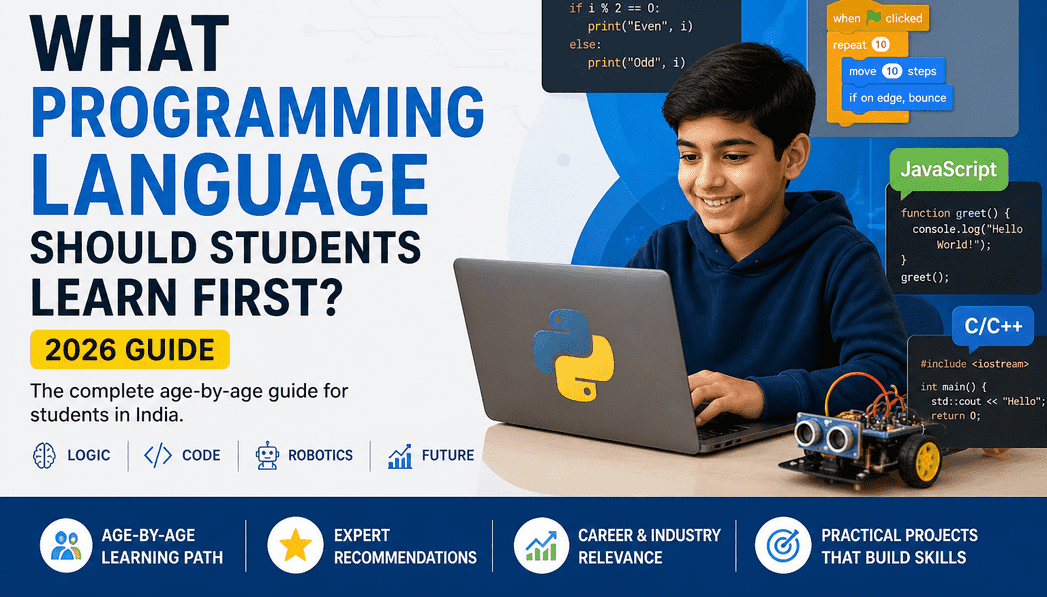
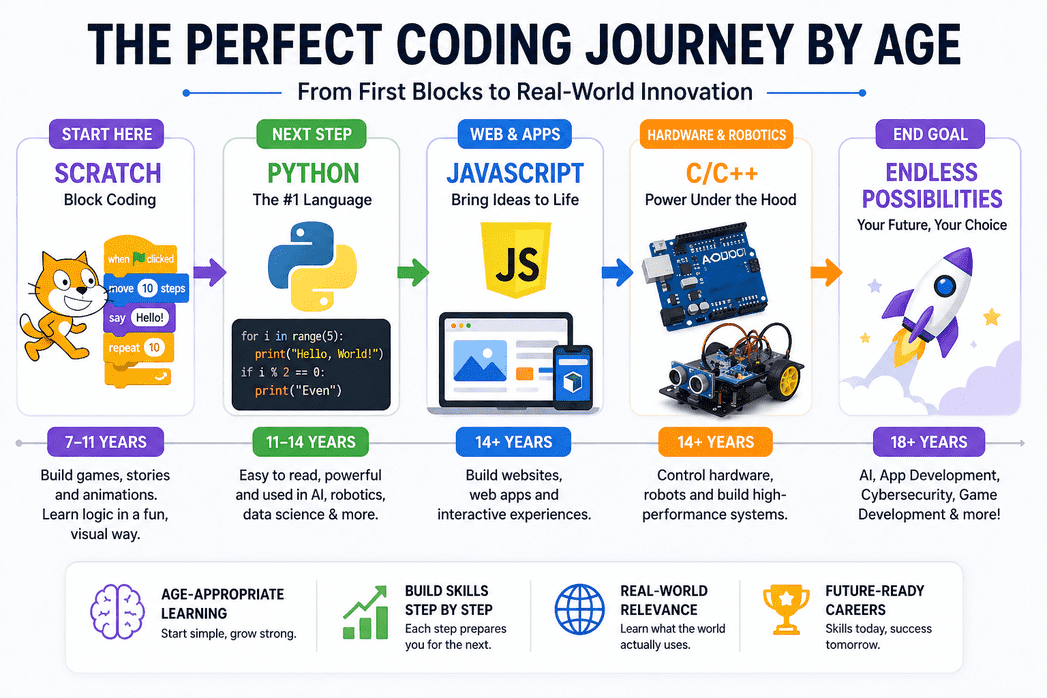
It depends on age - but here is the clearest answer for most students: Age 7–11: Start with Scratch - a free, visual block-based language made by MIT. No typing needed. Just drag, drop, and create. Age 11–14: Move to Python - the world's most popular language in 2026, beginner-friendly, and used in AI, robotics, and data science. Age 14+: Add JavaScript (for web/apps) or C/C++ (for robotics/hardware) based on your interests. The single best first "real" programming language for students in 2026 is Python. It is beginner-friendly, future-proof, deeply relevant to India's tech industry, and directly connected to the most exciting fields - AI, robotics, and data science.
Why the First Language Decision Matters More Than You Think?
Here is the truth that most coding tutorials skip: the first programming language you learn shapes how you think about problems for years. Choose the wrong one too early and a student spends months fighting confusing syntax instead of building things. They get frustrated, lose interest, and walk away from coding entirely - before they ever experienced what makes it exciting. Choose the right one and the student builds a game in their first week, writes a robot's movement code in their second month, and never looks back. Your first programming language sets the tone for your mindset, problem-solving style, career direction, and how quickly you can shift across technologies. And in 2026, relevance is the keyword - companies are hiring differently, AI-powered tools are changing workflows, and businesses expect developers to build fast and fix smart. This guide removes the confusion. By the end, you will know exactly which language your child should start with, when to move on, and what the path looks like from first project to career-ready skill.
The Golden Rule: Age Before Language
Before you look at any language, ask one question: How old is the student?
This matters more than career goals, trending technologies, or what a friend's child is learning. A language that is perfect for a 14-year-old will completely overwhelm an 8-year-old. A language designed for 8-year-olds will bore and under-challenge a 15-year-old.
Here is the age-based starting framework:
| Age Group | Starting Point | Why |
|---|---|---|
| 7–10 years | Scratch (block coding) | No typing needed, visual and creative, builds logic |
| 11–13 years | Scratch → Python | Transition from visual to text-based with a gentle slope |
| 13–15 years | Python (directly) | Ready for real syntax, logical thinking is developed |
| 15–18 years | Python + JavaScript or C++ | Career-oriented learning, multiple paths open |
| 18+ years | Python or JavaScript first | Most practical for rapid career entry |
This is not a rigid rule - a motivated 10-year-old can absolutely begin Python. But these are the ranges where most students learn fastest and enjoy it most.
📖 Not sure whether to start with coding or robotics first? Read our guide: Coding vs Robotics: Which Should Students Learn First? →
Scratch - The Perfect First Step for Ages 7–11
What Is Scratch?
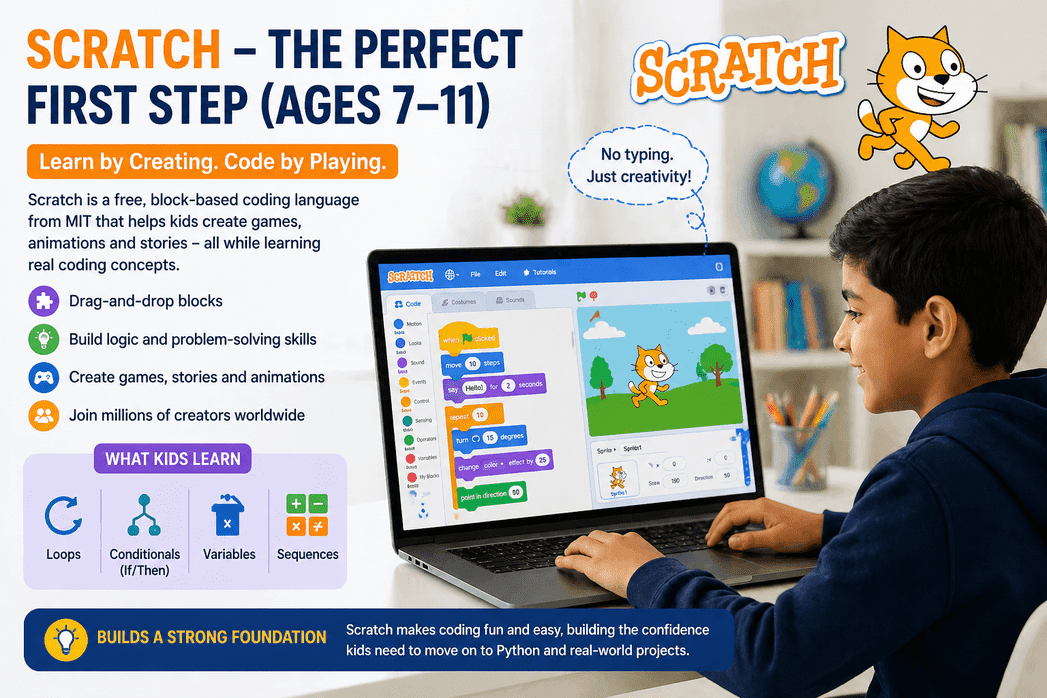
Scratch is a free coding language made for kids. Instead of typing lots of hard-to-understand code, kids use colourful blocks that fit together like a puzzle. These blocks tell characters - called "sprites" - what to do, like moving or changing colours. It is a fun way to make games, animations, or stories on the computer.
Scratch was created by MIT (Massachusetts Institute of Technology) - one of the world's top universities - and is used by millions of students and teachers globally, including in Harvard's introductory programming class.
Why Scratch Is Genuinely the Best First Step?
The biggest enemy of a young coder is not difficulty - it is frustration. When a beginner writes text-based code, a single missing comma or bracket breaks everything. That kind of invisible, confusing error kills enthusiasm instantly.
Scratch eliminates the "syntax barrier" entirely, letting kids focus on creativity and problem-solving instead. It is like building with digital LEGO - click, snap, run! The logic remains the same, but the frustration of forgotten semicolons and indentation errors disappears.
And the learning is real - not watered down. Scratch teaches important coding ideas like loops, if/then statements, and variables - the building blocks of more advanced coding languages.
Scratch Directly Prepares Students for Python
learning a new way to express the logic. Studies from MIT and Harvard show that students who begin with visual programming languages demonstrate 40% better retention of programming concepts compared to those who jump straight into text-based coding.
The transition looks like this:
- Scratch: "Repeat 10" block → Python: for i in range(10):
- Scratch: "If touching edge, bounce" → Python: if edge: bounce()
Same logic. Different expression. Students who start with Scratch learn the second part in a fraction of the time.
Getting Started with Scratch
- Website: scratch.mit.edu (free, no download needed)
- Best age: 7–12 years
- First project: A simple animation or a character that moves when you press arrow keys
- Time to first project: Under 30 minutes
Python - The #1 Language for Students in 2026
The Numbers Are Clear
Python is not just the most popular language for beginners. In 2026, it is the most popular language - period. Python continues to hold a dominant position in the global programming landscape. In the November 2025 TIOBE Index, Python retains the top spot with over 23% share, keeping it well ahead of every other language. The Stack Overflow Developer Survey states that 57.9% of respondents use Python, a 7-point increase from 2024, showing its growing popularity - largely due to AI adoption. According to GitHub's 2024 Octoverse report, Python surpassed JavaScript in 2024 to become the most popular language on the platform . Python has been the #1 language on the TIOBE Index since November 2025 - and the gap between Python and every other language is growing, not shrinking.
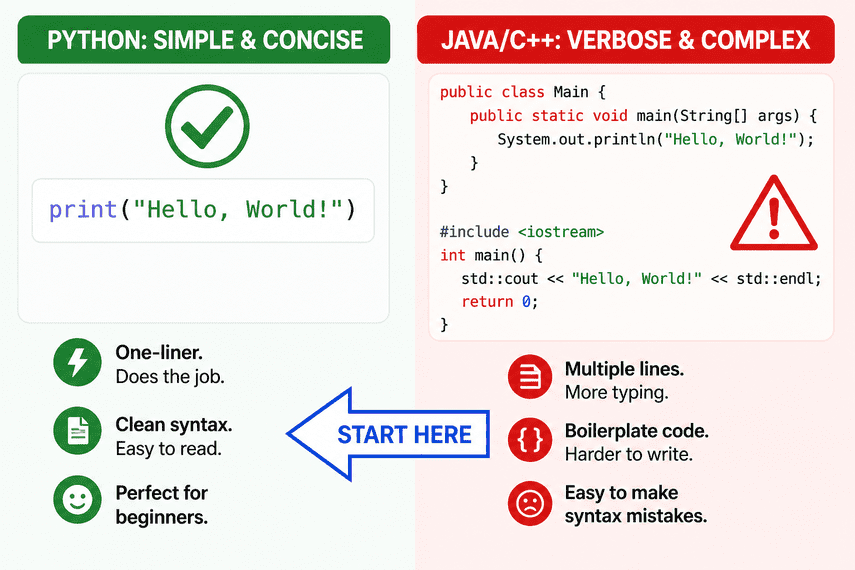
Why Python Is Perfect for Students It reads like English. Python's syntax is so clean that even a complete beginner can read a Python program and roughly understand what it does. Compare these two programs that both print "Hello, World!":
-
Python- what a student writes print("Hello, World!")
-
Java - what the same thing looks like public class Main { public static void main(String[] args) { System.out.println("Hello, World!"); } }
Same output. Python takes one line. Java takes six. For a student learning to code, that difference in cognitive load is enormous.
It is used for the most exciting things in technology:
- Artificial Intelligence - ChatGPT, Google's AI tools, and virtually every major AI system is built with Python
- Data Science - analysing data, finding patterns, making predictions
- Robotics - programming robot behaviours, sensors, and decision-making
- Web Development - building websites and web applications (using Django and Flask)
- Automation - making computers do repetitive tasks automatically
It is the language India's tech industry runs on. Python is the primary skill requirement across India's top technology companies - Infosys, Wipro, TCS, Flipkart, Zomato, and virtually every AI and data-driven startup in Bengaluru, Hyderabad, and Pune. Job portals like Naukri and LinkedIn India consistently rank Python as the single most in-demand technical skill, driven by the explosion of AI and data science roles across Indian industry.
What Does Python Pay in India? The average annual Python developer salary in India ranges from INR 3.2L for freshers to INR 7.6L for someone with 4 years of experience. The average salary for a Python developer with 2 years of experience is 13 lakhs per annum, ranging between 8.6 and 21.6 lakhs per annum for experienced professionals.
For students who go deep into AI and machine learning with Python, senior-level roles in India regularly cross ₹20–35 LPA.
What Can a Student Build in Python? A student who has learned Python basics (1–3 months of practice) can build:
- A quiz game
- A weather app using free APIs
- A basic chatbot
- A simple calculator or budget tracker
- A program that sorts and analyses data from a CSV file
After 6–12 months:
- An AI-powered image recognition program
- A web scraper that collects data automatically
- A machine learning model that predicts outcomes
- Code that controls an Arduino board and its sensors
Is Python in the CBSE Curriculum?
Yes. CBSE has introduced Python as the primary programming language in Computer Science from Class 11 onward, replacing C++ as the default language for many schools. Students preparing for board exams in CS will directly use Python - making it the single most strategically important language to learn for Indian school students.
🚀 Want Your Child to Start Coding With Real Hardware? At StepSTEM, students don't just learn - they write code that makes an actual Arduino truck move. That's the difference between knowing code and understanding it. Book a Free Trial Class → | Start With Code Wheels
JavaScript - When Web or App Development Is the Goal
If a student's dream is to build websites, mobile apps, or interactive games that run in a browser - JavaScript should come after Python (or alongside it at the 14+ stage).
JavaScript is widely used by a majority of developers, with 66% of Stack Overflow's 2025 Developer Survey respondents reporting that they had used it in the past year. A majority of the web's most popular sites - from Facebook and Twitter to Gmail and YouTube - rely on JavaScript to create interactive web pages and dynamically display content to users.
JavaScript is unique because it runs directly in every web browser - no installation, no setup. A student can write JavaScript in Chrome's developer console and see results instantly. That immediate feedback loop is excellent for learning.
When should a student learn JavaScript?
- After achieving basic proficiency in Python or
- If their primary interest is web/app development from the start
- Typically suited for students aged 13 and above
What can you build with JavaScript?
- Interactive websites and landing pages
- Web games (like Chrome Dinosaur, Flappy Bird clones)
- Full web applications (using React.js)
- Mobile apps (using React Native)
- Browser extensions
📖 Ready to build your first website? Check out our guide: 5 Beginner Web Development Projects Students Can Build to Start Coding →
C/C++ - The Hidden Foundation (Robotics + Arduino)
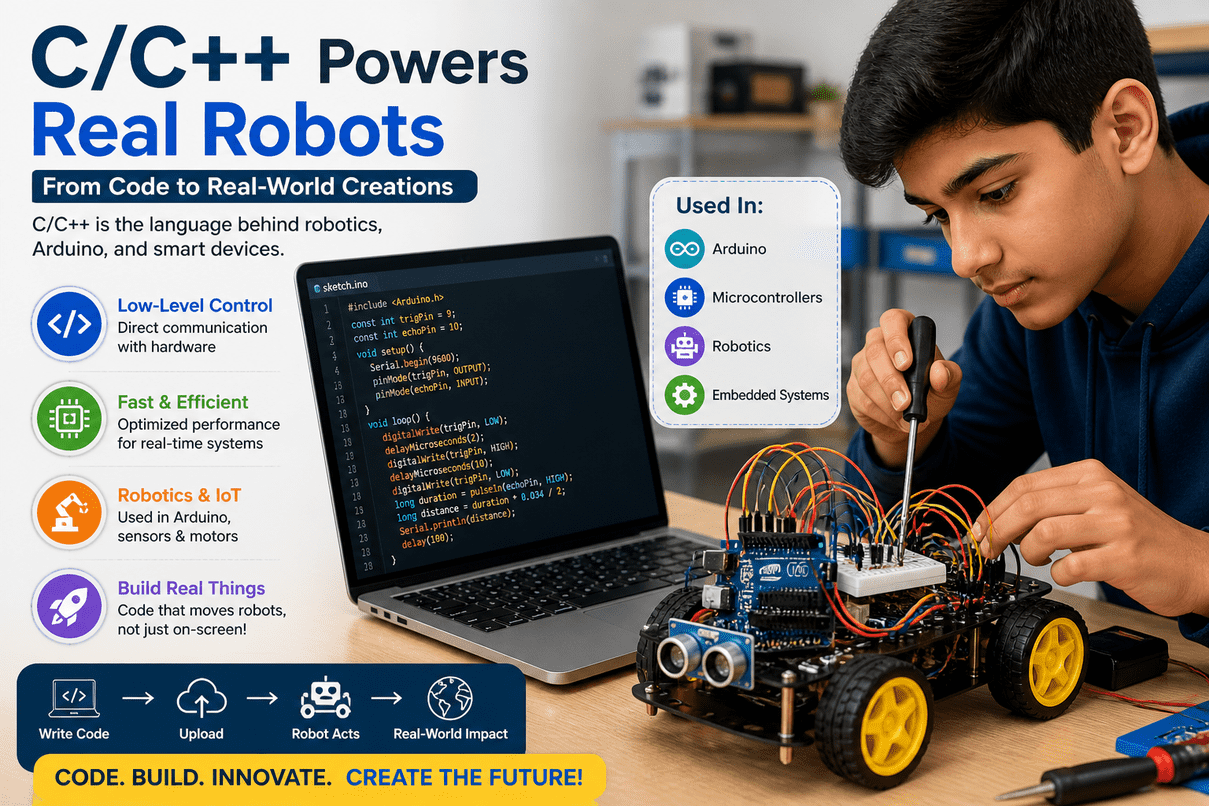
This is the language most coding guides skip - but for STEM students interested in robotics, hardware, and electronics, C/C++ is essential.
Why? Because microcontrollers like the Arduino - the brain of most beginner robotics projects - are programmed using C/C++. When a student at StepSTEM writes code for their Arduino-powered truck, they are writing C/C++.
What makes C/C++ important for STEM students:
- It is the language of embedded systems - devices like traffic lights, medical equipment, satellites, and industrial robots all run on C/C++
- It teaches students how computers actually work at a low level - memory, processing, hardware communication
- It is a strong foundation for computer science at the college level (JEE aspirants who study C/C++ find programming concepts much easier)
C and C++ are where serious programming foundations are built. They help students understand how computers work at a deeper level and are widely used in robotics and embedded systems. Learning C and C++ sharpens problem-solving skills and improves understanding of memory management - skills that transfer to every other language.
Should a student start with C/C++? Not as the very first language. The syntax is significantly more complex than Python, and it can be discouraging for absolute beginners. However, if a student is already learning robotics - especially with Arduino kits like the ones from StepSTEM - learning C/C++ as part of a hands-on project is one of the most effective ways to pick it up.
All Languages Compared in One Table
| Language | Best Age | Difficulty | Used For | India Career Relevance | Start With? |
|---|---|---|---|---|---|
| Scratch | 7–12 | ⭐ Easiest | Games, animations, logic | Foundation only | ✅ Yes, for young beginners |
| Python | 11+ | ⭐⭐ Easy | AI, data science, robotics, web | 🔥 Extremely High | ✅ Yes, best first real language |
| JavaScript | 13+ | ⭐⭐ Easy–Medium | Web, apps, games | 🔥 Very High | After Python or as parallel |
| C/C++ | 12+ | ⭐⭐⭐ Medium | Robotics, hardware, competitive coding | 🔥 High (JEE, embedded) | As part of robotics/STEM projects |
| Java | 14+ | ⭐⭐⭐ Medium | Enterprise apps, Android | 🔥 High (IT companies) | After Python |
| Kotlin | 15+ | ⭐⭐⭐ Medium | Android apps | Medium | After Java/Python |
| TypeScript | 16+ | ⭐⭐⭐ Medium | Web development | Growing | After JavaScript |
What Language Do Indian Schools and Competitive Exams Use?
This is the most India-specific and practically important section for students and parents here.
CBSE Schools and NEP 2020
India's National Education Policy (NEP) 2020 mandates computational thinking and coding as part of the school curriculum from Class 6 onward - a direct policy push that makes learning Python early not just smart, but nationally aligned.
Under NEP 2020 implementation, here is how coding languages map to each school stage:
- Class 6–10: Introduction to Scratch, basic HTML, and introductory Python concepts
- Class 11–12 (Computer Science): Python is the primary language - replacing C++ in most CBSE school curricula after NEP 2020
- Class 11–12 (Informatics Practices): Python + SQL
- CBSE Board Exam (Class 12 CS): Python questions are directly asked - learning Python early gives students a clear academic advantage
The government's Atal Tinkering Labs (ATL) initiative - with over 10,000 labs set up across Indian schools - also heavily features Python and Arduino-based projects as their core learning tools. Students who are already familiar with both languages arrive at an ATL lab ready to build on day one, not spending weeks on basics.
Competitive Exams and Olympiads
- JEE (IIT entrance): No direct coding questions, but students who understand C/C++ and Python have a significant edge in problem-solving approach
- KVPY / NTSE: Science and logic - STEM fundamentals that are built through coding practice
- International Olympiads (IOI, ACM-ICPC): C/C++ is the dominant language used by Indian competitors
- Coding Olympiads (CodeChef, HackerRank for schools): Python and C++ are the most used languages
CBSE Class 12 Python Topics Students Must Know
- Variables, data types, input/output
- Conditional statements and loops
- Functions and recursion
- Lists, tuples, dictionaries
- File handling
- Basic data structures
- MySQL database connectivity with Python
Students who start Python early - in Class 6 or 7 - arrive at Class 11 with deep fluency, not just surface-level exam preparation. That confidence changes everything.
The Recommended Learning Path by Age (India-Specific)
This is the roadmap we recommend at StepSTEM for every student:
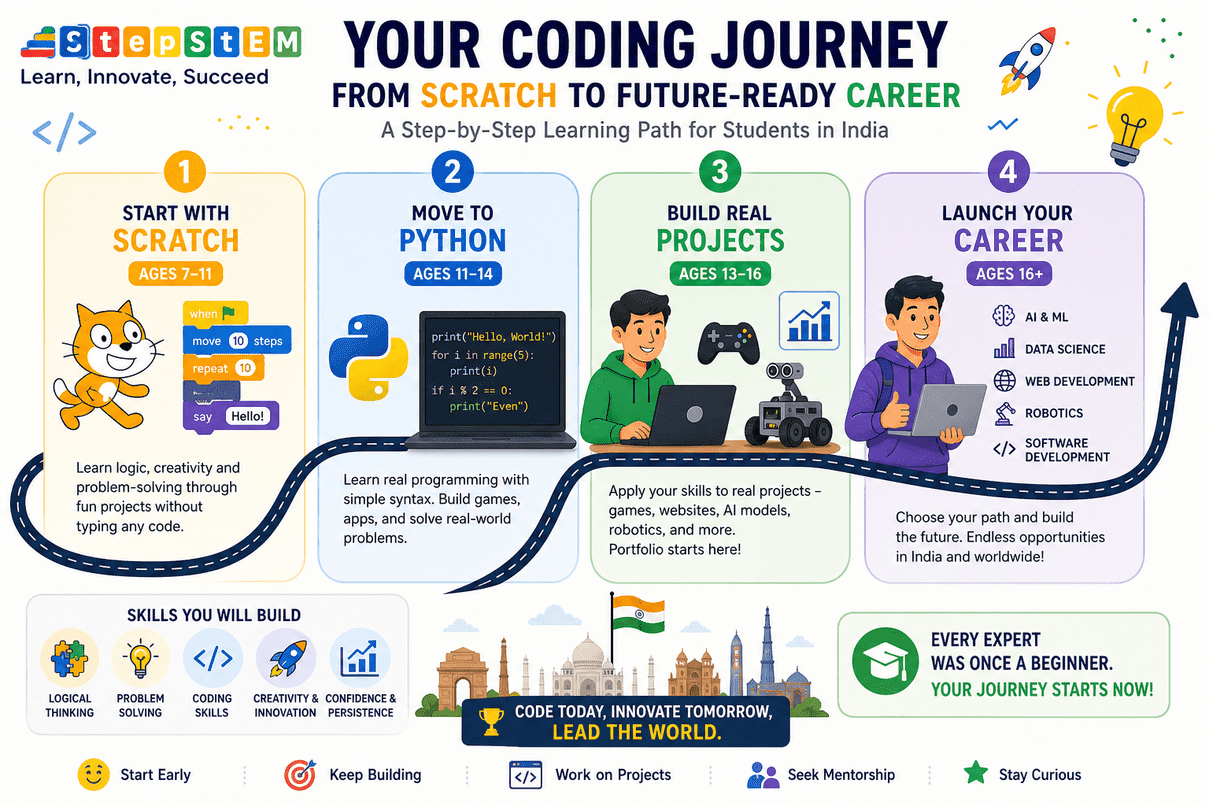
Age 7–10: The Curiosity Stage
- Start with: Scratch (scratch.mit.edu - free)
- Goal: Build 5–10 projects. Learn loops, conditions, events, and basic logic through games and animations.
- Time: 3–6 months of 2–3 sessions per week
Age 10–12: The Foundation Stage
- Add: Python basics - variables, loops, conditions, simple functions
- Tools: IDLE (free with Python download), Thonny (beginner-friendly)
- Goal: Write 10–15 small programs.
- The classic milestones: calculator, number guessing game, quiz program.
- Time: 4–6 months
Age 12–14: The Builder Stage
- Deepen: Python - functions, lists, dictionaries, file handling, beginner OOP
- Add: Start learning how to build small projects with real purposes (not just practice exercises)
- Goal: Build at least 2–3 projects you would be proud to show someone
- Milestone: Can read and adapt Python code you find online. Can debug your own errors.
Age 14–16: The Explorer Stage Branch based on interest:
- Interested in AI/Data? → Python + NumPy + Pandas + basics of machine learning
- Interested in Web/Apps? → Python + HTML/CSS + JavaScript
- Interested in Robotics/Hardware? → Python + Arduino C/C++ + IoT projects
- Interested in Competitive Coding? → Python + C++ (for speed-critical problems)
Age 16–18: The Portfolio Stage
Goal: Build a portfolio of real projects that you can show in college applications, scholarship interviews, and future job applications.
- Participate in coding competitions (HackerRank, CodeChef)
- Contribute to open source projects
- Build something that solves a real problem you care about
- Prepare for CBSE Class 12 Python board exam with deep confidence
📖 Need project ideas to build your portfolio? Read: 10 Easy STEM Projects Students Can Build to Start Learning →
Common Mistakes Students (and Parents) Make
Mistake 1: Choosing a Language Based on What's Trending, Not What's Appropriate
Rust, Go, and TypeScript are excellent languages - but they are built for experienced developers, not beginners. Choosing them because someone said they are "the future" is like handing a 10-year-old the keys to a Formula 1 car. Start with Python. Master the fundamentals. The advanced languages will come easily later.
Mistake 2: Learning Without Building
Coding is not school. It is a skill - like carpentry or cooking. You learn by doing, not by studying for six months first. Students who watch tutorials and read books without writing actual code make very slow progress. The rule is: for every 30 minutes you learn, spend 30 minutes building.
Mistake 3: Trying to Learn Multiple Languages at Once
A student who half-learns Python and half-learns Java knows neither. Pick one language. Go deep. Fluency in one language is worth ten times more than surface-level exposure to five.
Mistake 4: Starting Too Late
There is no such thing as "too late" to start coding - but there is a real cost to starting later. A student who begins Python at age 12 has 6 years of practice before they enter college. A student who starts at 17 has 1. The compounding effect of early learning is enormous.
**Mistake 5: Stopping After the First Frustration
**Every coder has a story about the bug that took 3 hours to find and turned out to be a missing colon. That frustration is not a sign you are bad at coding. It is a sign you are learning coding. The students who push through that first difficult week discover something remarkable on the other side.
Conclusion: The Best First Programming Language Is the One Your Child Actually Builds With
There is no shortage of opinions about the best programming language for students to learn first. But the right answer is not the one most popular on Reddit, or the one that pays the most in Silicon Valley, or the one your neighbour's child is learning.
The best first programming language is the one your child will actually use to build something they are proud of.
For most students in India in 2026, the answer to "what programming language should students learn first?" follows this clear path: Scratch (logic) → Python (foundation) → Specialise (AI / Web / Robotics)
At StepSTEM, we make that journey concrete - not theoretical. Our students do not watch videos about coding. They write code that makes a truck move, a sensor respond, a light blink. And that difference - between reading about code and writing code that does something real - is everything.
Book Your Free Trial Class → Browse Our Beginner Projects →
Questions? Write to us at connect@stepstem.in or call +91 81780 70172. We are based in New Delhi and work with students across India.
Frequently Asked Questions (FAQs)
What programming language should a 10-year-old learn?
A 10-year-old should ideally start with Scratch if they have no prior coding experience - it teaches the logic of programming without requiring typing skills or syntax knowledge. If a 10-year-old is already comfortable with Scratch or is particularly motivated, they can begin Python basics with the right guidance.
Is Python the best first programming language for students?
For students aged 11 and above, yes - Python is the best first programming language in 2026. It is beginner-friendly with clean, readable syntax, the world's most popular language by multiple measures, used directly in AI and robotics, aligned with CBSE Class 11–12 Computer Science curriculum, and leads to strong career opportunities in India.
Should students learn Scratch before Python?
For younger students aged 7–11, Scratch is the ideal starting point before Python. It teaches coding logic visually without the frustration of syntax errors. Students who learn Scratch first transition to Python significantly faster and with better retention.
Is Python used in CBSE schools in India?
Yes. CBSE has made Python the primary language for Class 11–12 Computer Science and Informatics Practices under NEP 2020. Students who learn Python early have a significant advantage in board exams and school-level competitive coding.
What programming language is used in robotics?
Most beginner robotics projects (especially those using Arduino) use C/C++. More advanced robotics systems use Python - particularly for AI-based decision making, computer vision, and machine learning components. At StepSTEM, students work with Arduino (C/C++) from their very first project.
How long does it take to learn Python?
A student can learn basic Python (enough to write simple programs and understand the fundamentals) in 2–3 months of consistent practice at 30–45 minutes per day. Practical fluency - enough to build real projects confidently - typically comes after 6–12 months. True mastery is a continuous journey.
What programming language should a student learn for AI?
Python is the definitive answer for AI in 2026. All major AI frameworks - TensorFlow, PyTorch, scikit-learn, and the OpenAI API - are Python-based. Any student interested in artificial intelligence, machine learning, or data science should start and stay with Python.
Can a student learn coding online in India?
Absolutely. Platforms like StepSTEM deliver live online coding instruction combined with physical project kits shipped directly to students across India. This hybrid approach - real online instruction + hands-on hardware - produces far better results than video tutorials alone.
What is the salary of a Python developer in India?
The average annual Python developer salary in India ranges from INR 3.2 lakhs for freshers to INR 7.6 lakhs for someone with 4 years of experience. Senior Python developers specialising in AI and machine learning can earn ₹20–35 LPA and above.