Offline vs Online STEM Learning: Which Is Better for Students?
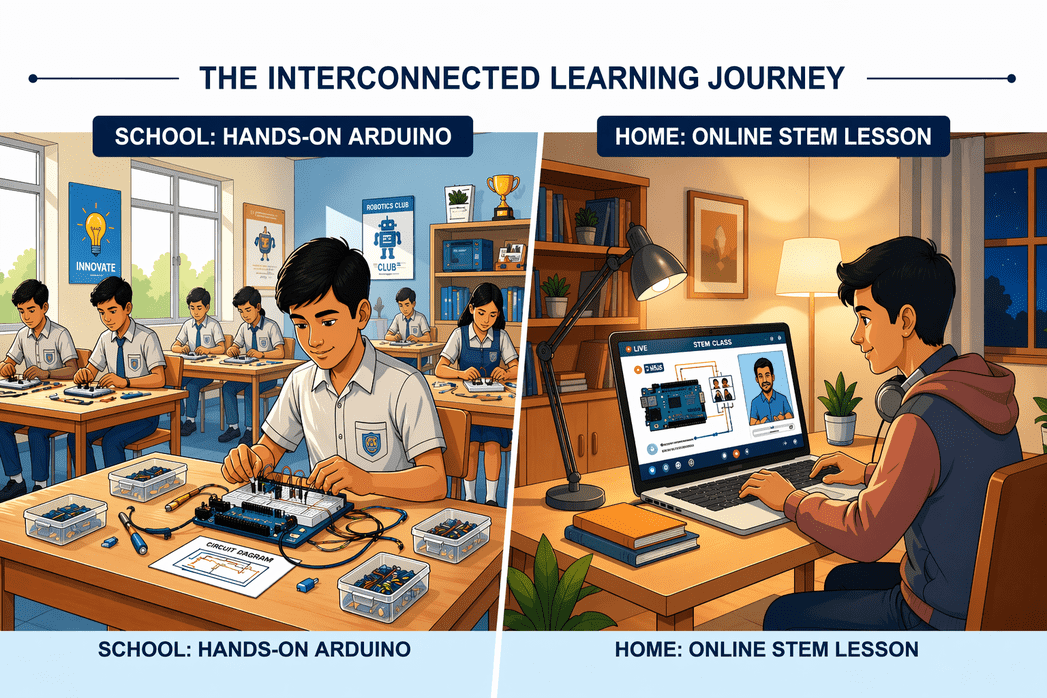
For most students in Class 6 to 10, the answer is not one or the other - it is both, in the right balance. Offline STEM learning delivers the physical, multi-sensory experience that makes engineering concepts truly stick: touching wires, watching motors spin, and debugging a real circuit. Online STEM learning delivers flexibility, access, and the ability to revisit concepts at any pace. In 2026, the most effective model - and the one StepSTEM has built its entire curriculum around - is a hybrid approach: physical kits delivered to your home, taught live by expert instructors online. You get the hands-on depth of offline learning without leaving your living room.
Defining the Two Formats
Before comparing them, it helps to be precise about what each term actually means in the context of STEM education for school students.
Offline STEM Learning
Offline learning refers to in-person, physical instruction - whether in a school lab, a coaching institute, a robotics club, or an Atal Tinkering Lab. The defining feature is that the student, the tools, and the instructor are all in the same room. The student can pick up a sensor, wire a breadboard, and get real-time correction from a teacher standing next to them.
Online STEM Learning
Online learning refers to digital instruction accessed through a screen - pre-recorded video courses, live virtual classes, or self-paced platforms. The student may be learning the same concepts, but they are doing so remotely, typically without physical components in front of them unless the platform specifically ships a kit.
The Critical Distinction for STEM: Unlike subjects like History or English, STEM education involves building, testing, and debugging physical systems. This makes the "online vs offline" debate especially important - because a student who only watches videos about circuits is fundamentally different from one who wires a circuit with their own hands.
The Case for Offline STEM Learning
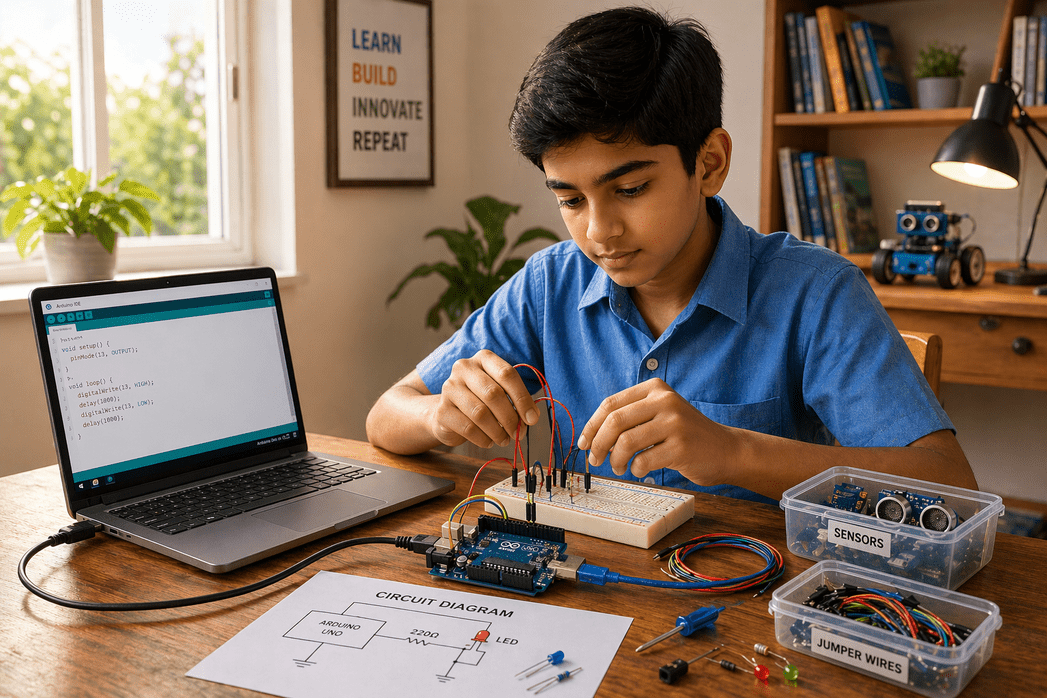
Offline STEM learning has one irreplaceable advantage: it is physical. When a student assembles a circuit and the LED fails to light up, they do not see an error message - they feel the problem. They check the connections, measure voltage with a multimeter, swap components. That debugging process, done with real hands on real hardware, builds a quality of understanding that no video can replicate.
Immediate, Multi-Sensory Feedback
In an offline STEM environment, the feedback loop is instantaneous and physical. A motor that spins the wrong direction, a buzzer that sounds when it should not, a robot that turns left instead of right - these are not abstract errors. They are visible, audible, tangible events. Research consistently shows that multi-sensory learning improves retention and conceptual depth, particularly for engineering and science subjects.
Stronger Collaboration and Communication
Offline learning naturally creates collaboration. Students working side by side on a robot chassis negotiate, debate, and divide tasks in real time. This mirrors how engineering actually works in professional environments - in teams, with conversation, with shared physical tools.
Alignment with NEP 2020
India's National Education Policy 2020 explicitly emphasizes experiential and hands-on learning from Class 6 onwards. Offline, project-based STEM learning is the primary vehicle through which schools are implementing this mandate - through Atal Tinkering Labs, science fairs, and robotics clubs.
Limitations of Pure Offline Learning
- Geographic restriction - quality offline STEM labs are concentrated in metro cities (Delhi, Bengaluru, Mumbai)
- High cost - physical lab infrastructure, equipment, and trained instructors are expensive to maintain
- Fixed scheduling - students must attend at a specific time and place, limiting flexibility
- Scalability gap - one instructor can only work with a small number of students at once
The Case for Online STEM Learning
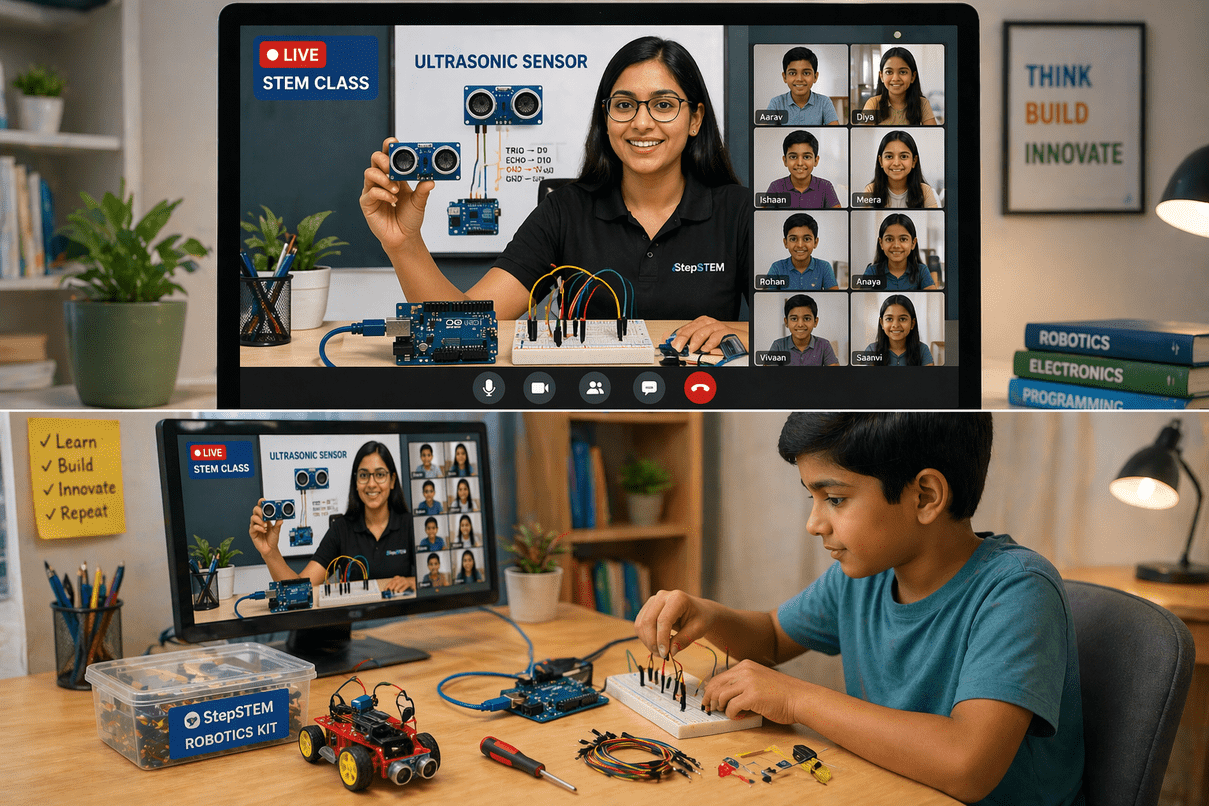
The global e-learning market is expected to reach $400 billion by 2026, and STEM subjects account for 50% of all online learning resource usage among school students. The shift toward online STEM education has been accelerated by improved internet access, affordable devices, and - critically - platforms that have figured out how to make remote learning genuinely engaging.
Accessibility and Reach
The most powerful argument for online STEM learning is that it removes geography as a barrier. A student in Raipur, Varanasi, or Aizawl can access the same quality of instruction as a student in South Delhi - as long as they have a laptop and an internet connection. For a country as geographically diverse as India, this is transformative.
Flexible Pacing
Online STEM platforms allow students to revisit complex concepts - rewatching a video on how ultrasonic sensors calculate distance, for example - as many times as needed. This self-paced element is particularly valuable for students who need more time to absorb technical content before moving on.
Cost Efficiency
Online STEM courses are more affordable than in-person alternatives. Studies indicate that creating and delivering digital learning content costs substantially less than in-person instruction. For families outside metros, online learning eliminates travel, accommodation, and material costs associated with attending a physical STEM institute.
Limitations of Pure Online Learning
- Without physical components, students only observe STEM - they do not practise it
- Screen fatigue is a real challenge, particularly for younger students in Class 6–7
- Self-discipline is required - 60% of students new to online learning report low motivation in the early weeks
- The absence of hands-on troubleshooting means students do not develop the debugging instincts that offline learning naturally builds
Head-to-Head Comparison: Offline vs Online STEM Learning
-Hands-on Experience: Offline STEM learning gives students full physical engagement with tools, circuits, robots, and experiments. Online STEM learning may provide practical exposure only if kits are included.
- Accessibility: Offline learning is limited to cities, schools, or centres with proper STEM labs. Online learning is accessible anywhere with a laptop/mobile and internet connection.
- Feedback Loop: Offline learning offers instant real-world feedback. Students can immediately see errors in circuits, coding, or robotics projects. Online learning may involve delayed responses or simulations.
- Cost: Offline STEM learning is usually more expensive because of lab setup, equipment, travel, and maintenance costs. Online STEM learning is more budget-friendly and reduces extra expenses.
- Scheduling Flexibility: Offline classes happen at fixed times and locations. Online learning allows students to learn at their own pace and choose convenient timings.
- Instructor Quality: Offline instructor quality depends on the school or local coaching centre. Online platforms provide access to experienced and expert instructors from across India.
- Collaboration: Offline STEM learning naturally encourages teamwork, peer interaction, and group problem-solving. Online collaboration is possible but needs structured sessions and digital tools.
- NEP 2020 Alignment: Offline STEM directly supports experiential and hands-on learning goals of NEP 2020. Online STEM supports these goals only when it includes projects, kits, and live interaction.
- Scalability: Offline learning is limited by physical space, number of labs, and available equipment. Online learning can reach thousands of students across India at the same time.
- Best For Offline Learning: Students who live near quality STEM labs, schools, or robotics centres and prefer classroom-based learning.
- Best For Online Learning: Students in smaller cities, towns, or remote areas who need flexible and affordable access to STEM education.
- Final Verdict: The best option is often a hybrid model—physical kits at home with live online guidance. This combines offline hands-on learning with online flexibility and accessibility.
The Hybrid Model: The Best of Both Worlds
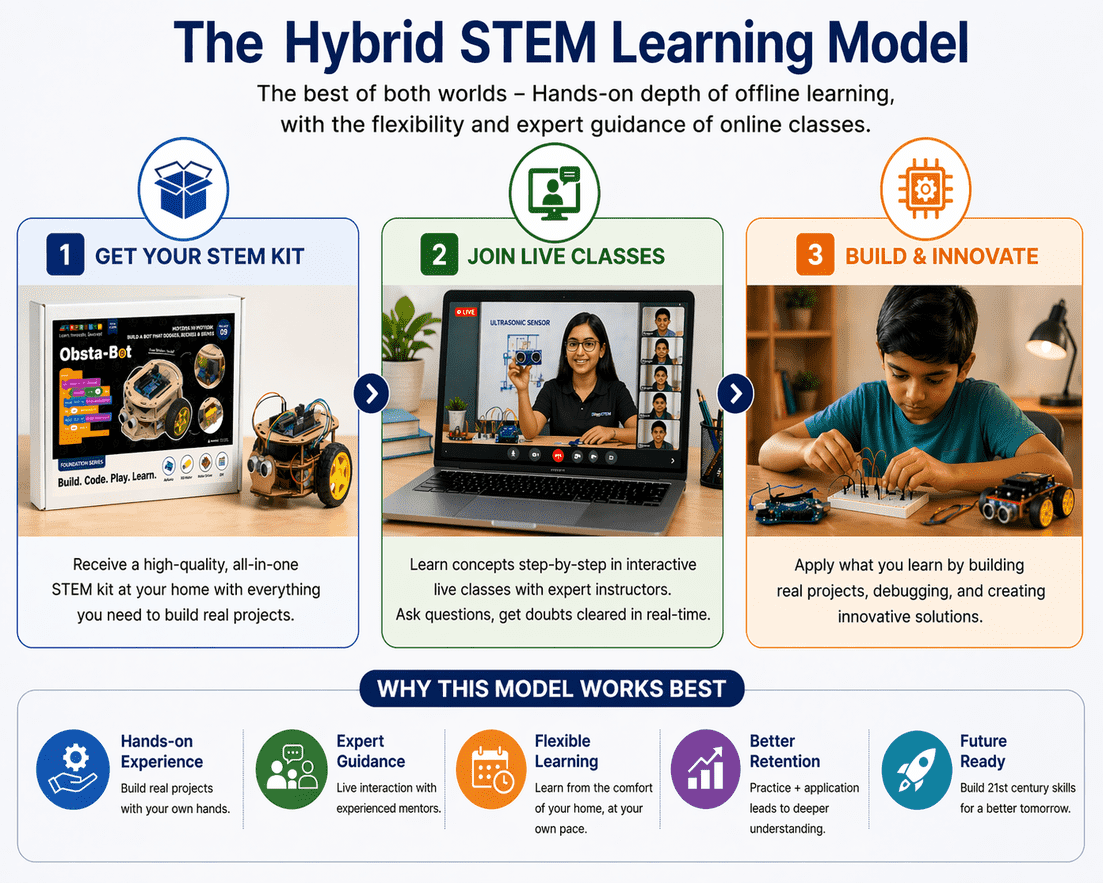
In 2026, the debate between offline and online is increasingly being replaced by a third path: the hybrid model. This approach delivers physical components directly to the student's home, and pairs them with structured live instruction conducted online. The student gets the hands-on, tactile experience of offline learning - but with the accessibility, affordability, and expert instruction quality of online education. This is precisely the model that StepSTEM has been built around. Every Foundation Series kit ships all required components directly to the student. The live online classes - conducted in real time by expert instructors - guide students through assembly, circuit connections, and coding step by step. The result: a Class 6 student in Nagpur has the exact same learning experience as one in New Delhi.
Why the Hybrid Model Works for STEM Specifically
- Physical components arrive at home - the hands-on experience is preserved, not replaced by videos
- Live instructor guidance replicates the in-person correction that pure online learning lacks
- Students can pause, rewatch recorded sessions, and review slides at their own pace
- No travel, no lab fees, no fixed location - the flexibility of online with the depth of offline
How StepSTEM Bridges the Gap
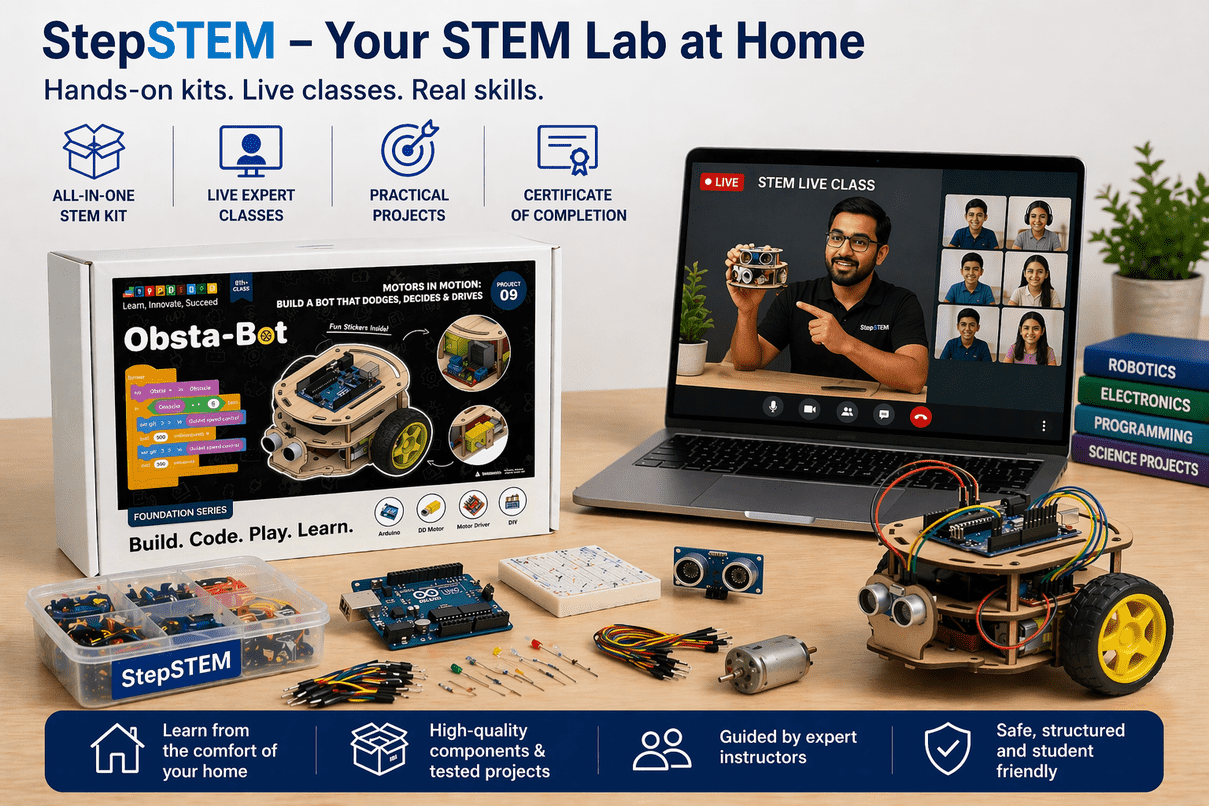
StepSTEM's Foundation Series is specifically designed to solve the core problem of online STEM education: the absence of physical experience. Here is how the model works in practice:
| What StepSTEM Provides | Why It Matters |
|---|---|
| Physical innovation kit | Every component pre-selected and quality-checked - students build with real hardware, not simulations |
| Live online classes (2 per project) | Expert instructors guide assembly and coding in real time, replicating the quality of offline lab instruction |
| Full-time access to slides | Students revisit lessons at their own pace - the flexibility advantage of online learning is preserved |
| Project assignments | Structured assessments reinforce every concept before the student moves to the next project |
| Anytime support | Students and parents can reach StepSTEM instructors between sessions - no question goes unanswered |
From Code Wheels ( Arduino + LED circuits) to Obsta-Bot ( fully autonomous robot), every StepSTEM kit delivers genuine hands-on engineering at home - guided by expert instruction online. Visit stepstem.in/courses/beginner to explore the full Foundation Series.
Conclusion
The debate between offline and online STEM learning is, ultimately, a false choice. The real question is not where the learning happens - it is whether the student is building something real. A student who assembles an autonomous robot at their kitchen table, guided by a live instructor on a laptop screen, is getting a richer engineering education than one who watches STEM videos on YouTube or sits in a school lab where the equipment is shared and supervised time is scarce.
In 2026, the best STEM education for Class 6 to 10 students is hybrid, structured, and hands-on - exactly what StepSTEM's Foundation Series delivers. Nine progressive projects, live expert instruction, physical components shipped to your home, and a curriculum that prepares students for national and international competitions, engineering entrance exams, and a lifetime of building things that work.
For parents deciding between formats: the right question to ask about any STEM course is not "is it online or offline?" - it is "will my child build something real by the end of it?" If the answer is yes, the format does not matter. At StepSTEM, the answer is always yes.
StepSTEM helps students explore robotics, coding, and real STEM projects through hands-on learning. Start building today - book a free trial at stepstem.in
Frequently Asked Questions
Is online STEM learning as effective as offline for Class 6–10 students?
For theoretical understanding, online STEM learning can be equally effective. However, for developing practical engineering skills - circuit building, sensor calibration, motor control - online learning without physical components is significantly less effective than offline. The key variable is whether the online course includes real hardware. StepSTEM's model ships components to the student, making online delivery as hands-on as an offline class.
Which format is better for students in smaller cities and towns in India?
For students outside major metros, online learning with a physical kit is the superior choice. Quality offline STEM labs are concentrated in Tier 1 cities. A student in a Tier 2 or Tier 3 city who enrolls in a kit-based online course like StepSTEM's Foundation Series gets the same quality of hands-on instruction as a student in Delhi or Bengaluru.
Can a parent with no technical background support online STEM learning at home?
Yes. StepSTEM's Foundation Series is specifically designed so that parents do not need any prior electronics or coding knowledge. The live instructor handles all technical guidance. The parent's role is simply to ensure the student has a quiet space, a laptop, and the kit - the learning is fully managed by the instructor during live sessions.
What is the biggest drawback of pure online STEM learning?
The biggest drawback is the absence of physical components. A student who only watches STEM videos develops theoretical awareness but not engineering intuition - the ability to look at a wiring problem and diagnose it by instinct. This is why kit-based hybrid platforms outperform both pure offline (expensive, geographically limited) and pure online (no physical component) models for school-age STEM education.
How does StepSTEM's hybrid model compare to traditional school STEM labs?
Traditional school labs have three key limitations: equipment is shared among many students, lab time is limited to fixed school hours, and the quality of instruction varies significantly between schools. StepSTEM's model gives every student their own dedicated kit, unlimited access to recorded sessions, and consistent expert instruction - all from home. For most students, this is a meaningfully richer STEM experience than a school lab visit.